
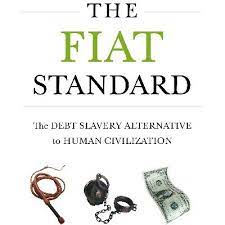
The Fiat Standard
Lending is the fiat version of mining meaning you mine fiat tokens by issuing debt.
Fiat emerged because of gold’s low salability across space.
All fiat currencies are essentially a layer 2 derivative of the USD.
Under the fiat standard, each central bank has four important functions:
- A monopoly on its respective fiat coin in determining its supply and price.
- A monopoly on clearing international payments.
- A monopoly on authority over-regulating domestic banks, holding their reserves, and clearing payments between them.
- Lending to its respective national government by buying its government bonds.
A government’s control over trade allows them to use their private economy as collateral to squeeze foreign exchange revenue.
There is a huge difference between a recession-induced deflation—which is only possible with an inflationary credit collapse—and productivity- benevolent-driven deflation.
Harder money that grows in value over time relative to goods and services will discourage frivolous spending, but it won’t stop people from buying necessities. Even goods that aren’t necessary may still be bought as there is still value in buying it today even though prices will fall in the future (think most forms of technology like storage or televisions).
The biggest flaw of the CPI is it lacks any objective metric by which to measure prices. The CPI is just a mathematical tautology referencing prices in dollars as a way to measure the changes of prices in dollars.
CPI is based on consumer spending and won’t account for changes in spending habits due to increased prices. As prices soar and consumers can’t afford goods, the quality of those goods is usually lowered to balance out with the prices they can afford, which is not accounted for in CPI.
M0 = total number of fiat tokens printed into physical form.
M1 = M0 + bank checking accounts.
M2 = M1 + savings deposits and certificates of deposits.
M3 = M2 + money market mutual funds and other large forms of liquid assets.
In many instances, success in a fiat system means accumulating larger negative cash balances.
Managing to secure debt at a lower interest rate is the most significant market advantage in a fiat system. This is why we see businesses issuing credit and attempting to arbitrage their low borrowing rate with higher consumer credit rates.
Without fractional reserve banking, capital and labor would flow to the highest bidder and that tends to be the entrepreneur who uses capital and labor most productively.
Fiat systems encourage high time preferences in all areas of the economy which is short-term serving and long-term damaging.
The fiat standard and tendency toward cheaper, lower quality food has brought us vegetable/seed oils, widespread use of corn and corn syrup, the prevalence of soy as a substitute for healthier and more expensive alternatives, a move to low-fat foods, and the popularity of whole grain flour and sugar.
The government funding of schools disallows parents or students the opportunity to leave that school (take their money elsewhere) for another. Having no competition or voting system through spending choices leads to a decline in the quality of education.
Though private schools are expensive, public schools generally spend more per student and return worse results. To solve this, governments should simply take that money and give it to parents as a school credit so they can choose where to spend it and foster a healthy marketplace of educational institutions competing for those dollars.
Academia has created a model where academics work to get published (for no direct financial gain) so publishers can profit off their work. There is also no market feedback on the value of the work creating a huge disconnect between market-valued information and what the centralized publishers and committees decide is valuable.
The IMF’s ability/tendency to bailout foreign countries is akin to the Fed’s tendency to bailout its private sector, which inspires the recipients of the bailouts to take on more risk given they have a lender of last resort as a safety net.
You can classify the cost of fiat into four categories:
- The destruction of holders’ wealth through inflation.
- The destruction of the role of money in economic calculation.
- The increased power of the government to shape the economy and society.
- The increased cost and likelihood of conflict.
The benefits to fiat are primarily in the savings around not transporting gold.
A curse of inflation is attracting investors to unprofitable investments through nominal profits despite them boasting negative real returns.
Fiat’s proof of work is military might and awards the winner the accounting system for all of society. This system incentivizes countries to engage in power contests rather than purely economic ones.
Bitcoin offers a significantly easier, faster, and cheaper payment alternative for banks and sovereigns making large transactions, but it takes too long and costs too much for very small purchases to be practical, which underscores the importance of layer 2 solutions like the lightning network.
The lightning network addresses the per transaction cost and instant settlement problems for Bitcoin without sacrificing security, but is currently lacking in liquidity and will need more channels to be built out to support a whole economy of transactions.
Money optimizes liquidity at the expense of risk and return and equity optimizes return at the expense of liquidity.
Under a hard money system, there will be growth in cash balances as 0% nominal returns become positive real returns and companies see cash as a more attractive financial instrument than debt.
The abundance of cash will also reduce the return on lending meaning naturally lower interest rates.
Without a lender of last resort or the bank’s ability to create money through credit, savers will be exposed to unlimited downside and very limited upside when storing a deposit with that bank. Unless banks offer access to the upside of the investments its depositor’s money is being allocated toward rather than the traditional minuscule fixed interest rate, there will be little incentive to use banks.
Bitcoin’s difficulty adjustment ensures the cost of mining a Bitcoin always tracks closely to its trading price.
Bitcoin mining is incentivized to find the cheapest power and is location agnostic making it a perfect candidate for utilizing wasted power such as flared methane from oil fields.
When the Bitcoin mining subsidy (reward) vanishes in 2140, the security of the network will have to be incentivized through transaction fees.